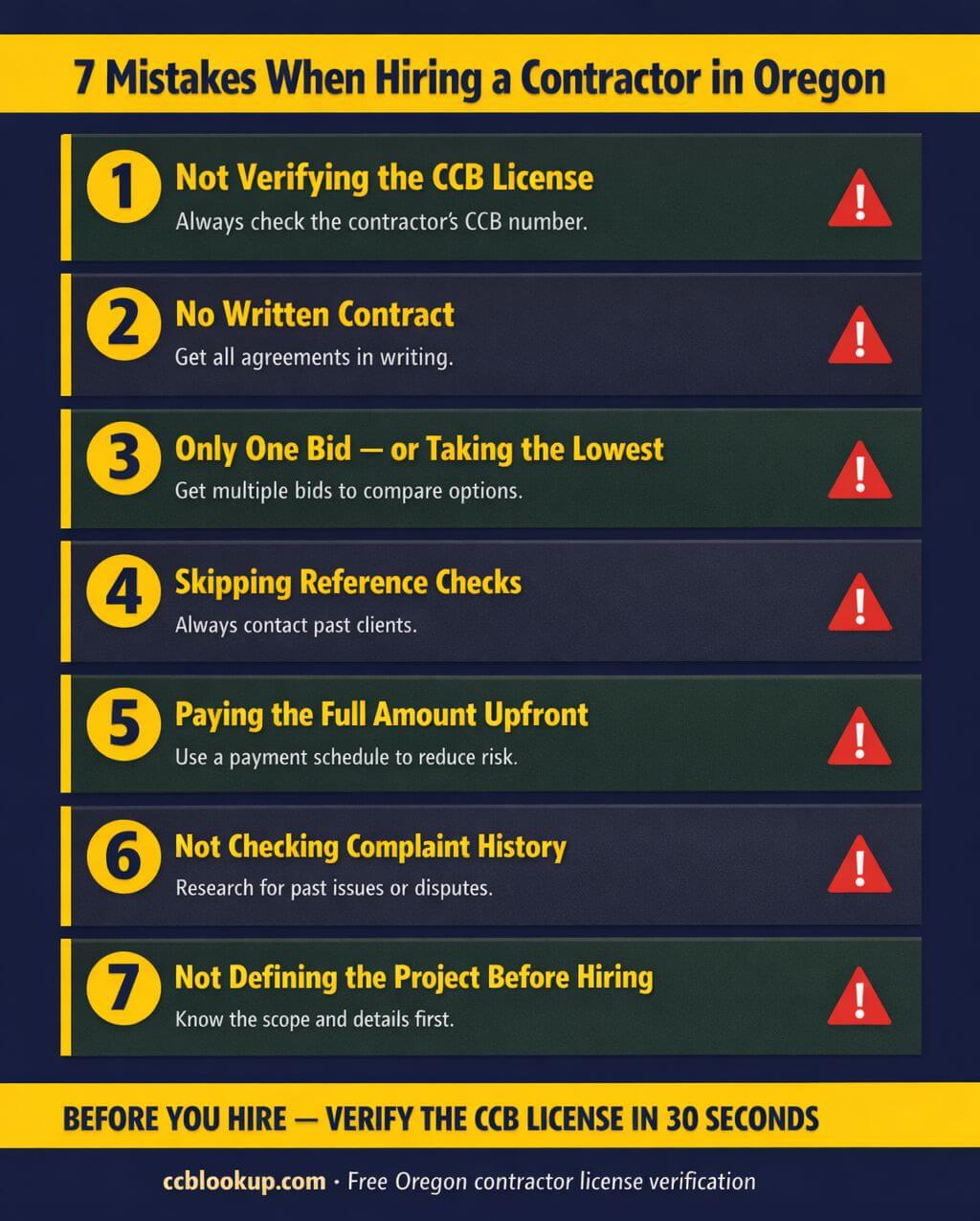
8 Mistakes to Avoid When Hiring a Contractor in Oregon
Most contractor disputes in Oregon are preventable. The same mistakes come up again and again - here's how to avoid every one of them.
Mistake #1 starts with not verifying the license. Check any Oregon CCB license in seconds.
Not verifying the CCB license
This is the most consequential mistake - and the easiest to avoid. Oregon requires every construction contractor to hold a valid CCB license. A license means the contractor is bonded and insured. Without it, you have no bond to claim against if work is abandoned or substandard, and no access to the CCB's complaint and mediation process.
Search the CCB license before any conversation about price or timeline. It takes 30 seconds. Confirm the license is Active, the bond hasn't expired, and the business name matches what the contractor told you.
Check again on the day work starts. The CCB recommends verifying the license on the actual start date - not just when you sign the contract. A license can expire, lapse due to a bond or insurance gap, or be suspended in the weeks between signing and breaking ground. A second 30-second check on day one keeps you protected.
Not getting a written contract
Oregon law requires written contracts for construction work over $2,000 - yet verbal agreements remain one of the most common sources of CCB disputes. A proper written contract is your primary protection if things go wrong.
What every Oregon contractor contract must include
- Contractor's name, business name, and CCB number - the business name must match the name on the CCB license exactly.
- Full scope of work - every task, room, and system covered. Vague scope language like "remodel kitchen" is not a scope - specific materials, dimensions, and finishes are.
- Materials and allowances - brand names, model numbers, or minimum specs for all materials. If the contractor will select materials within a budget, specify the allowance amount explicitly.
- Total price and payment schedule - payment tied to defined milestones (demolition complete, framing complete, rough-in complete, project complete), not to calendar dates.
- Start date and estimated completion date - with a clause specifying what happens if the schedule slips significantly.
- Change order process - any scope, material, or price change must be documented in a signed written change order before the work proceeds. Verbal change orders are the most common source of disputes.
If a contractor resists putting any of these details in writing, treat it as a serious red flag. A contractor confident in their work and pricing should have no problem committing it to paper.
Only getting one bid - or automatically taking the lowest
Get at least three bids for any significant project. Multiple bids help you understand what the project should actually cost and reveal whether any contractor is cutting corners or padding margins.
A bid significantly lower than the others is often a warning sign - not a bargain. It may indicate substandard materials, underpaid workers, or a contractor planning to add costs through change orders after work begins. The Oregon CCB notes that "a price too good to be true often turns into a construction nightmare."
Not checking references
Oregon does not require construction contractors to hold trade-specific training (unlike plumbers and electricians). This makes references more important, not less. Ask for contact details of past customers on similar projects.
Questions to ask: Was the work completed on time? Did the contractor return calls? Were there unexpected cost increases? How were problems handled? Look at examples of the contractor's work where possible - especially for visible finish work like tiling, painting, or cabinetry.
Paying the full amount upfront
Never pay the full contract amount before work begins, and never pay in cash. A reasonable deposit (typically 10-30% depending on project size) is normal. The remainder should be tied to project milestones: framing complete, rough-in complete, project complete.
Full upfront payment removes your leverage entirely. If something goes wrong, the contractor has every incentive to walk away.
The surety bond on a licensed contractor's record provides some protection - but prevention is better. Unpaid subcontractors and suppliers may file a mechanics lien against your property within 75 days of their last work, even if you've already paid the general contractor.
Write checks to the business name on the license, not to an individual's name.
Not checking complaint and disciplinary history
CCB Lookup shows license status, bond, and insurance data. But the official CCB database also contains up to 10 years of complaint history, civil penalties, and license suspensions - information that can reveal a pattern of problems that no license check alone will surface.
Always check both: use CCB Lookup for license, bond, and insurance, then visit search.ccb.state.or.us to review complaint history.
How to interpret what you find
- One old complaint, resolved: Not necessarily a problem. The CCB mediation process frequently resolves legitimate disputes, and a single resolved complaint over a decade can be normal for an active contractor.
- Multiple complaints within 2–3 years: A pattern that warrants serious concern, regardless of outcome. Multiple complaints suggest recurring issues with workmanship, communication, or payment.
- Civil penalties: These indicate the CCB found a violation serious enough to impose a financial penalty. A recent civil penalty is a strong reason to choose another contractor.
- License suspension or revocation: The most serious finding. Even if the license is currently Active, a recent suspension indicates a significant past violation. Ask the contractor directly what happened and how it was resolved.
- Active license with recent complaint filed: A complaint in progress doesn't mean guilt, but it means the dispute is unresolved. Proceed with extra caution and request references specifically from recent projects.
The CCB complaint database covers residential and small commercial disputes. For large commercial projects, check both the CCB and the contractor's court record history.
Not planning the project before hiring
Contractors who start work with a vague scope are more likely to encounter disputes about what was agreed. Before you call anyone, define your project clearly: budget, timeline, specific materials and finishes you want, and what decisions you are willing to delegate.
Collect pictures of styles and finishes you like. Research brand names and models. Walk through a finished example with a potential contractor and point out what you like and don't like. The clearer your brief, the more accurate the bids - and the fewer surprises during construction. If significant changes arise during the project, document them in writing with a signed change order.
Ignoring lead-based paint on older homes
If your home was built before 1978, any renovation work that disturbs painted surfaces - sanding, scraping, demolition - can release hazardous lead dust. This is not a minor concern: lead exposure is particularly dangerous for children and pregnant women, and the health effects are permanent.
Oregon requires contractors performing renovation work on pre-1978 homes to hold a lead-based paint renovation license. This specialty credential is separate from the standard CCB license and confirms the contractor is trained in lead-safe work practices - containment, cleanup, and waste disposal.
How to verify lead-paint certification
On any CCB Lookup contractor profile, the endorsements section shows whether the contractor holds a lead-based paint renovation license. You can also verify on the contractor's full CCB record at search.ccb.state.or.us under "business detail." If the license is absent and your home predates 1978, ask the contractor directly - and get their lead certification number in writing before work begins.
Common projects that trigger the requirement include painting, window replacement, bathroom or kitchen renovations, and any work that involves sanding or scraping painted surfaces. When in doubt, assume the requirement applies and ask.
Frequently Asked Questions
Last updated: April 2026. Information sourced from the Oregon CCB Consumer Tools page and the official CCB Guide to Hiring a Contractor.
Before You Hire
Avoid mistake #1. Verify any Oregon CCB license in 30 seconds - free.
CCB License LookupHiring Checklist
- CCB license verified and Active
- Bond and insurance current
- Got at least 3 written bids
- References checked
- Complaint history reviewed on CCB.gov
- Written contract signed
- Payment tied to milestones
- Permits assigned in writing
- Change order process agreed
- Lead paint license (pre-1978 homes)
- Re-verified license on start day